Is The Blue Mosque Free To Enter? Entry Rules, Hours And Dress Code
The Blue Mosque charges no ticket, but free entry comes with conditions: modest dress, prayer-time pauses, and a visitor route that is not the same as a museum visit. Here is what free actually means at Istanbul's most photographed mosque.
Short answer
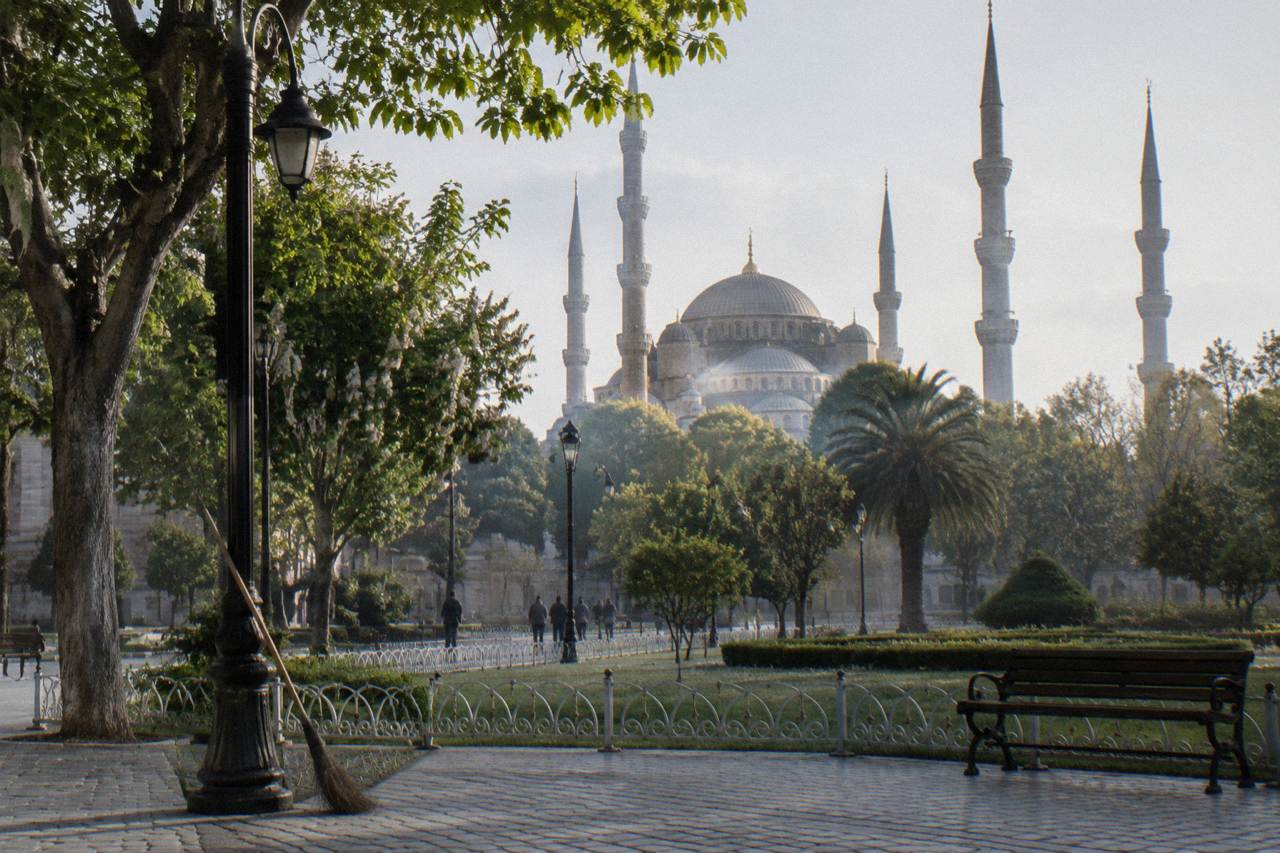
Yes, the Blue Mosque is free to enter, both as a worshipper and as a visitor. There is no museum ticket and no donation required. The conditions are modest dress and visiting outside prayer times, when the tourist entrance pauses for roughly 30 to 90 minutes per prayer.
Yes, the Blue Mosque is completely free to enter, both for worship and for visiting. There is no ticket desk, no suggested donation, and no separate museum charge of the kind Hagia Sophia now carries on its upper floor. The only real conditions are a modest dress code and timing your visit around the five daily prayers, when the tourist entrance closes for a pause. Free here means genuinely free, not free-with-an-upsell.
That last point matters more than most guidebooks admit. Sultanahmet's two great buildings, the Blue Mosque and Hagia Sophia, sit directly across a park from each other and are routinely described in the same breath, yet they now follow entirely different money models. One is a working mosque you walk into for free. The other is a working mosque with a paid museum route layered on top of it. Confusing the two is the single most common budgeting mistake visitors make in this neighbourhood, and it is worth untangling before you arrive. A free walk covers this ground: Best-Of Walk, English Or Spanish.
The Blue Mosque, formally the Sultan Ahmed Mosque, was built as an imperial mosque of the Ottoman golden age and has functioned as an active place of worship ever since. It has never charged an entry fee in the museum sense, because it was never converted into a museum in the first place. Hagia Sophia did go through a museum phase, complete with a paid ticket, before its reconversion to mosque use in 2020; the Blue Mosque did not. That divergent history is the reason the two buildings, thirty seconds' walk apart, cost different amounts to see today.
What Does Free Entry Actually Include?
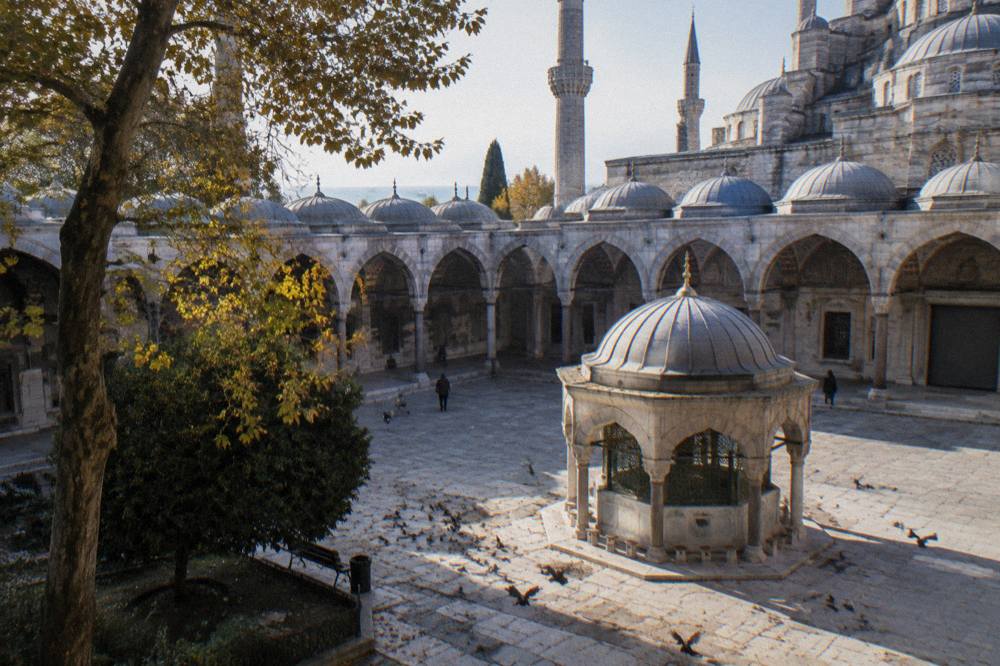
Free entry includes the main prayer hall's roped visitor zone, the inner courtyard, and the outer surrounding grounds, with no ticket, no donation request and no time limit imposed at the door. Everything a general visitor is entitled to see inside the Blue Mosque costs nothing; the exclusions are guided commentary, headsets, and restricted sections such as parts of the Imperial Box. A free walk covers this ground: 3-Hour Byzantine & Ottoman Tales.
That second half matters as much as the first. A free visit is self-guided by definition: nobody walks you through the tilework or points out the calligraphy panels, and there is no audio option inside the visitor zone. The mosque gives you the space; the interpretation is yours to bring.
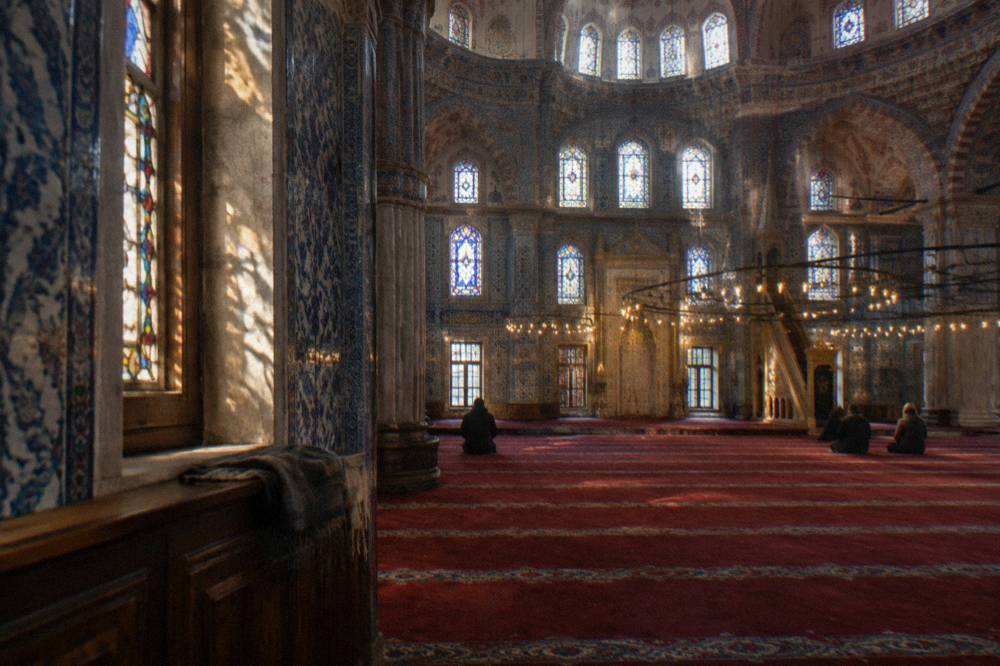
The visitor experience is structured, not chaotic. You enter through the tourist entrance on the north side of the complex, separate from the worshippers' entrance, remove your shoes at the door, and step onto the carpeted hall floor. The visitor area is roped off from the worship space, but the view across the full hall, its blue Iznik tiles, its stained glass, and its cascade of domes, is unobstructed. Photography is permitted in the visitor zone. You can stay as long as the mosque is open to visitors, and there is no one collecting money anywhere in the process.
This is also why the Blue Mosque pairs so well with a free walking tour rather than a paid guide. The mosque gives you the visual for free; the tour gives you the context. The Old City's most-reviewed free walk, the Byzantine and Ottoman Tales tour, is rated 4.98 out of 5 across 3,553 GuruWalk reviews, runs about three hours in English, and starts at Binbirdirek on Atmeydanı Caddesi, a short walk from the mosque's front gates. It costs nothing to reserve, the guide is paid by tips, and it covers the Hagia Sophia, the Hippodrome and the Blue Mosque's place in the Ottoman building programme in one loop of Sultanahmet. This stop sits on a free walking route, Kilim Weaving & Mosaic Lamps.
If you would rather explore the interior at your own pace, that works too. Information panels inside the visitor area cover the basics in several languages, and the mosque's sheer visual impact does most of the talking. What a walk adds is the why: why an Ottoman sultan built six minarets here, why the tiles are blue, and why the mosque deliberately faces the Hagia Sophia across the square. Those stories are the difference between seeing a beautiful building and understanding one.
A short comparison of what free gets you at each of the mosque's zones:
| Area of the Blue Mosque | Free to visitors? | Notes |
|---|---|---|
| Main prayer hall, visitor zone | Yes | Roped viewing area, photography allowed |
| Inner courtyard | Yes | Open outside prayer pauses |
| Outer grounds and gardens | Yes | Open at all hours |
| Imperial Box (Hünkar Mahfili) | No | Partially cordoned during restoration work |
| Guided commentary | No | Bring your own guide or take a free walking tour |
What Is The Dress Code For Free Entry?
The dress code requires covered shoulders and knees for everyone, shoes removed at the entrance, and head coverings for women, and the mosque supports all of it with free loan garments handed out at the tourist door. You never need to buy anything or arrive specially dressed: wraps, scarves and shoe bags are provided at no charge and returned on your way out.
The rules are not arbitrary gatekeeping. The Blue Mosque is an active house of worship holding five daily prayers, and the code is the same one applied at every mosque in the city. Practically, that means long trousers or a long skirt, a top that covers the shoulders, and a headscarf for women before stepping into the prayer hall. Shoes come off at the door and go into the plastic bags provided; you carry them or leave them on the racks. Socks are a sensible choice on winter mornings, when the stone floors are genuinely cold. One of the free walking routes passes through here: Haktan's Constantinople Walk.
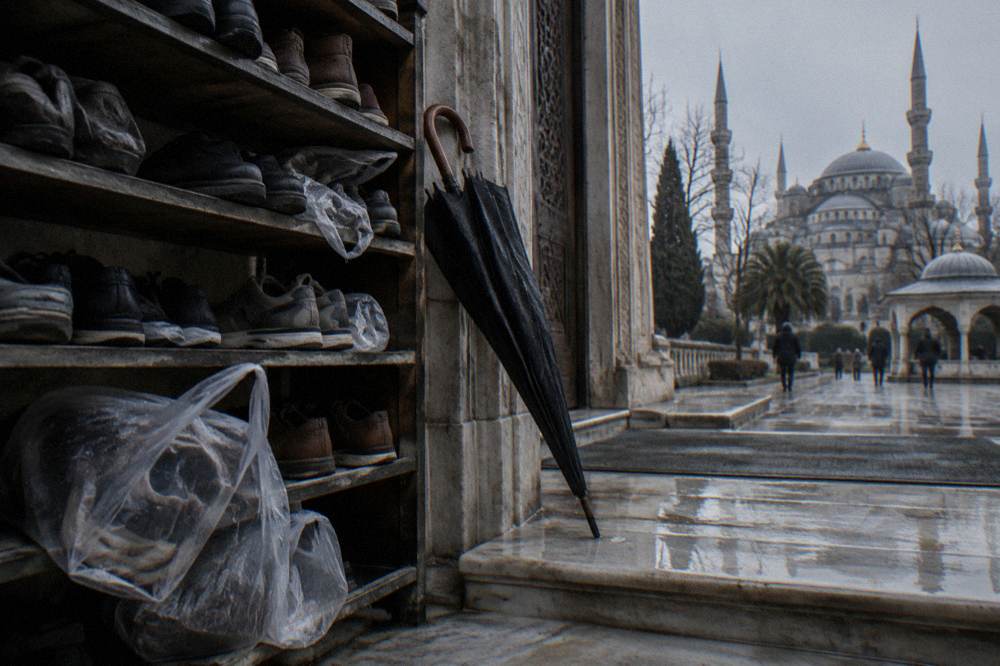
Visitors sometimes worry about getting the etiquette wrong. The site's own guide to what to wear visiting Istanbul's mosques for free covers the full checklist, but the short version is this: dress modestly, be quiet inside, do not photograph worshippers, and do not walk in front of someone praying. If a prayer session is running, stay in the visitor zone and simply wait. Nobody will challenge a respectful visitor, and the loan garments mean an unplanned visit never becomes a wasted trip.
One point worth repeating: nothing in the dress code costs money. The wraps, the scarves and the shoe bags are all provided free at the entrance, and there is no donation box positioned in the visitor path in the way some European cathedrals now use. Budget travellers can treat the Blue Mosque as a zero-cost visit with total confidence. One of the free walking routes passes through here: Mosque Inner Visit Included.
When Can You Visit? Opening Hours And Prayer Pauses
The Blue Mosque welcomes visitors every day of the week, but the tourist entrance pauses for roughly 30 to 90 minutes around each of the five daily prayers, with the longest closures falling on Fridays around the midday Jummah prayer. There is no fixed museum schedule because the mosque's day is structured by prayer times, which drift a few minutes daily and shift with the seasons. In winter the prayers fall earlier; in summer the evening visiting window stretches longer.
This is the one genuinely tricky part of a free visit, and it catches out a lot of itineraries. The five daily prayers, fajr, dhuhr, asr, maghrib and isha, do not sit at fixed clock times, so a visiting window that worked last month may now collide with a closure. The practical approach is to check a prayer-time app in the morning, aim for a mid-morning or mid-afternoon slot, and avoid Friday between roughly noon and 2 pm entirely. Outside those windows, the doors are simply open.
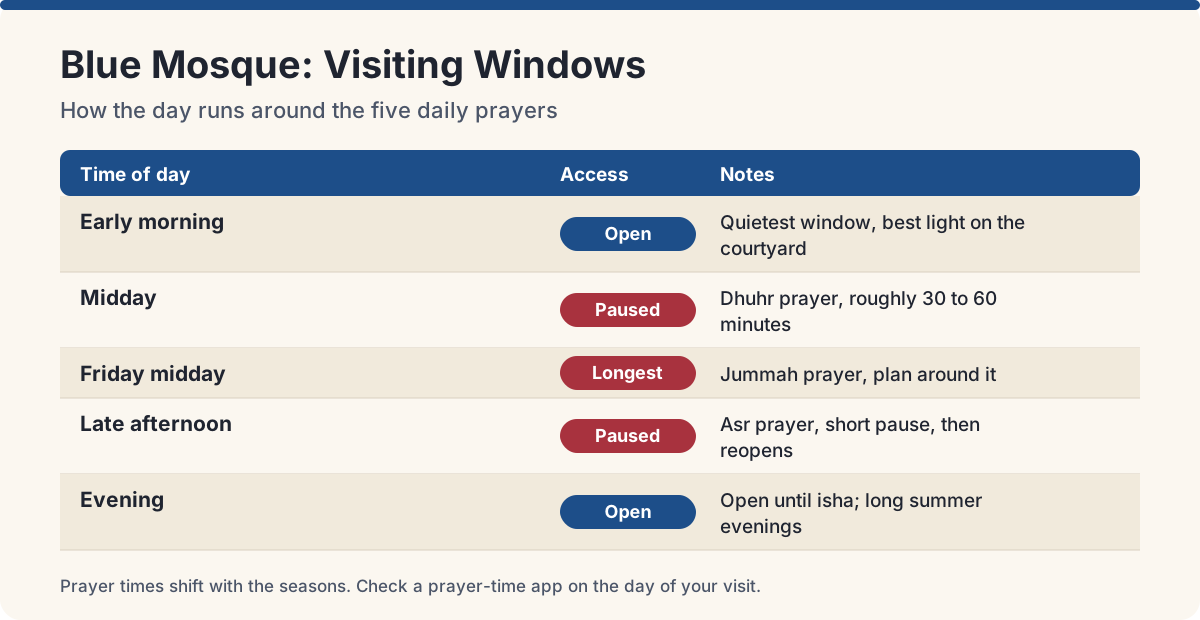
The good news is that a closure is never a long wait. Even the longest Friday pause clears within about two hours, and the mosque's outer courtyard and gardens, which are part of the free complex, stay walkable throughout. Many visitors use the pause to cross the park to the Hagia Sophia's exterior, walk the Hippodrome's surviving obelisks, or take tea at one of the cafes on Soğuk Çeşme Street, then return when the tourist entrance reopens.
A planning view of how the day typically breaks down:
| Time of day | Visitor access | Notes |
|---|---|---|
| Early morning | Open | Quietest window, best light on the courtyard |
| Midday | Paused for dhuhr | Roughly 30-60 minutes |
| Friday midday | Longest closure | Jummah prayer, plan around it |
| Late afternoon | Paused for asr | Short pause, then reopens |
| Evening | Open until isha | Summer evenings allow a long visit |
Blue Mosque Vs Hagia Sophia: Which One Is Actually Free?
The Blue Mosque is the free one in full, while Hagia Sophia is free only on its ground-floor worship space, with its upper gallery now carrying a dedicated ticket for foreign visitors. The two buildings face each other directly across a Sultanahmet park, yet they follow entirely different money models, and treating them as a matching pair will wreck your budget planning if you assume both cost nothing to enter.
The distinction is structural. Hagia Sophia spent decades as a state museum with a paid ticket before being reconverted into a mosque in 2020. A museum-style route was added to its upper gallery from January 2024, and foreign visitors now pay a dedicated ticket, reported at around 25 EUR, to walk it. The ground floor remains a free worship space, open to anyone entering to pray or to stand quietly in the nave. The Blue Mosque never went through the museum phase at all, so there is no gallery route, no ticket desk, and no layered pricing to untangle. The full breakdown lives in the site's guide to whether Hagia Sophia is free. One of the free walking routes passes through here: 3-Hour Old City & Daily Life.
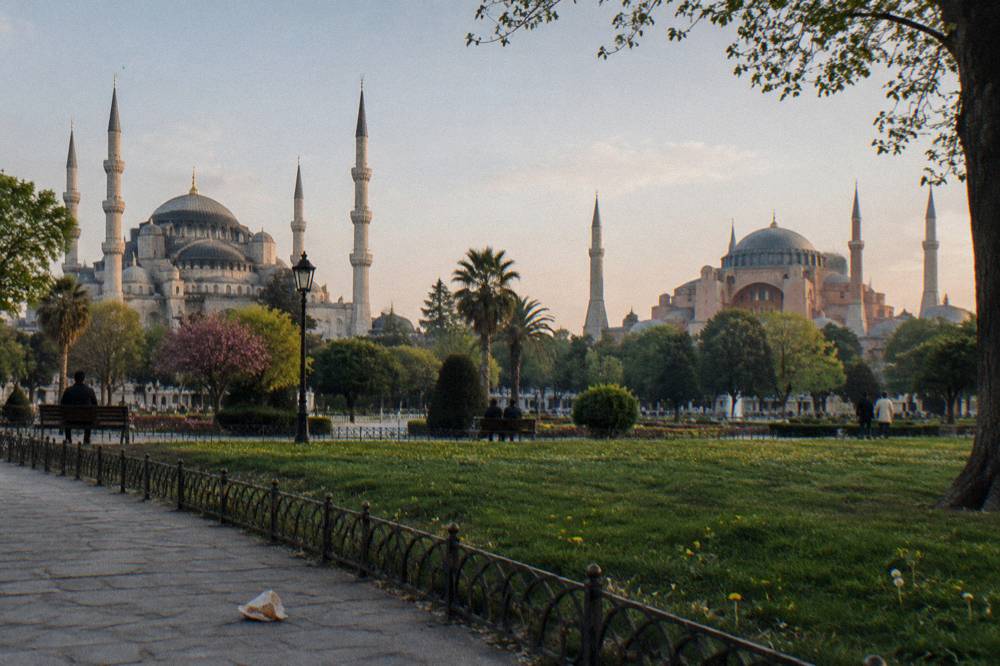
There is also a restoration angle that separates the two right now. Hagia Sophia is in the middle of a major structural restoration, with scaffolding inside and the main dome covered, though worship and visits continue uninterrupted, as Turkish press reporting on the eastern semi-dome work has confirmed. The Blue Mosque's own multi-year restoration, described as the most extensive in its history, is largely complete, with most of the interior visible again and only minor sections such as parts of the Imperial Box still cordoned. In practical terms, the Blue Mosque is currently the cleaner view of the two. A free walk covers this ground: Essentials In 2 Hours.
The budget picture across Sultanahmet's headline sites:
| Sultanahmet site | Free status | The catch |
|---|---|---|
| Blue Mosque | Fully free | Dress code and prayer pauses |
| Hagia Sophia, ground floor | Free worship space | Crowded, no museum commentary |
| Hagia Sophia, upper gallery | Paid, around 25 EUR for foreign visitors | Not covered by the Museum Pass |
| Hippodrome and its monuments | Fully free | Outdoor, minimal signage |
| Gulhane Park | Fully free | None |
Is The Restoration Finished? Visiting In 2026
The Blue Mosque's major restoration is largely complete, with most of the interior visible again and only minor sections, including parts of the Imperial Box, still partially cordoned. The courtyards are fully open, the minaret and structural work is finished, and the famous blue Iznik tiling is back on display, so visitors now see the mosque close to its intended appearance.
That was not true for much of the previous decade, which matters for planning: older reviews and blog posts describe a scaffolded, sectioned-off interior that no longer matches reality. If you read a trip report from a few years ago complaining about netting over the dome or closed viewing areas, that information is now stale. The current state is a mosque you can experience essentially as designed, with the caveat that a working historic building always has some maintenance somewhere.
The contrast with its neighbour across the park is worth knowing before you set expectations. Hagia Sophia's restoration is still very much live, with the main dome covered in canvas and steel platforms advancing to the eastern semi-dome, though the authorities have been explicit that the work does not interrupt worship or visits. So if your heart is set on an unobstructed dome view, the Blue Mosque is currently the safer bet of the two, and it costs nothing to check for yourself.
Free Walking Tours That Include The Blue Mosque
The Blue Mosque appears in the routes of several free Old City walking tours, all bookable at no upfront cost on GuruWalk, with each guide paid by tips at the end of the walk. The most-reviewed option, the Byzantine and Ottoman Tales walk, is rated 4.98 out of 5 across 3,553 GuruWalk reviews and runs roughly three hours in English, treating the mosque as one chapter in the story of Ottoman Sultanahmet.
A walk solves the one thing free entry to the mosque cannot give you: interpretation. Walking in costs nothing and tells you nothing about why the building looks the way it does. The tour guides in this neighbourhood are locals working on the tip model, meaning you reserve a place for free, join the group, and pay what you think the walk was worth when it ends. There is no minimum, and the roster of free tours across the Old City is large enough that you can be selective.
The walk that suits a Blue Mosque-focused visit best is the Byzantine and Ottoman Tales tour, whose route runs from Binbirdirek past the Hippodrome and both great buildings, and whose review pool is the deepest in the neighbourhood.
If your interest runs more toward daily life than imperial history, the Old City's daily-life walk, rated 4.96 out of 5 across 1,823 GuruWalk reviews, spends its three hours on the lived-in streets around the monuments, and the Discover Istanbul walk, rated 4.91 out of 5 across 1,803 reviews and offered in both English and Spanish, covers the essentials in two and a half hours for visitors on a tighter schedule. All three meet within a few minutes' walk of the mosque's gates, so you can tour first and visit the interior after, or the reverse, timed around the prayer pauses.
What Else Is Free Around The Blue Mosque?
Everything in the immediate Sultanahmet perimeter outside the ticketed state museums is free to walk: the Hippodrome's surviving monuments, Gulhane Park, the green park between the two great buildings, and the cobbled streets of Cankurtaran. You can spend a full day in this neighbourhood without paying a single entry fee, provided you skip Hagia Sophia's paid gallery and the Ministry of Culture sites.
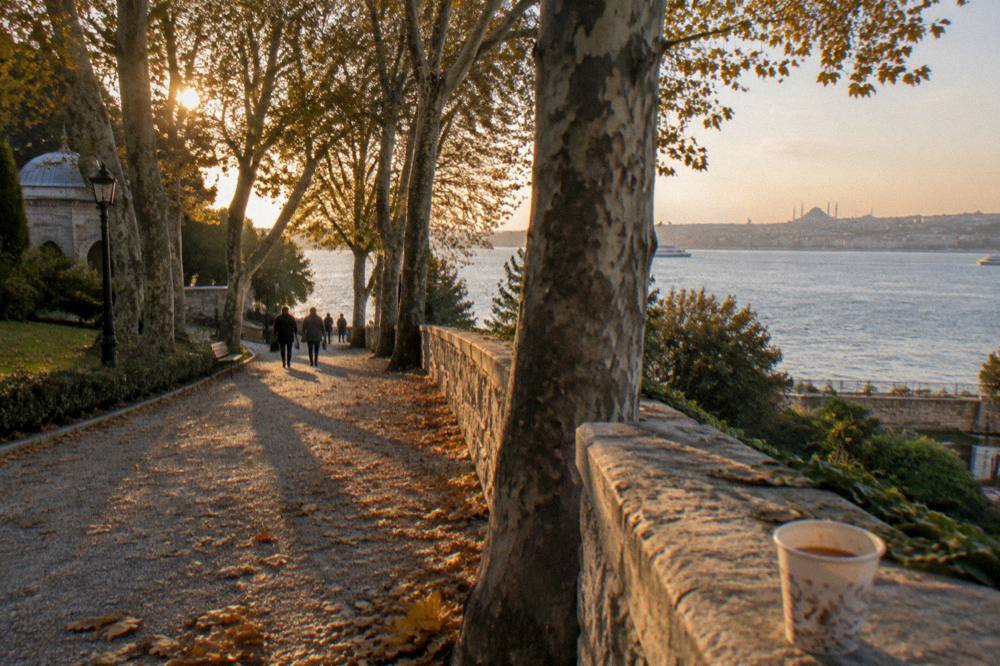
Start with the Hippodrome, the long plaza directly beside the mosque, which preserves the Egyptian Obelisk, the Serpent Column and the Column of Constantine in open public space. Then drop down through Gulhane Park, the old palace grounds now a free public garden running down toward the Bosphorus. Soğuk Çeşme Street, the cobbled lane of wooden houses between the park and Topkapi's walls, is one of the most photographed free streets in the city. None of it has a gate, a ticket or a closing time beyond daylight.
When you have exhausted the Old City, the same free-walk model extends across the water. The Two Continents walk, rated 4.94 out of 5 across 2,735 GuruWalk reviews, starts on Soğuk Çeşme Street itself and uses the public ferry to cross to the Asian side, a two and a half hour English-language tour that turns the commute into the attraction.
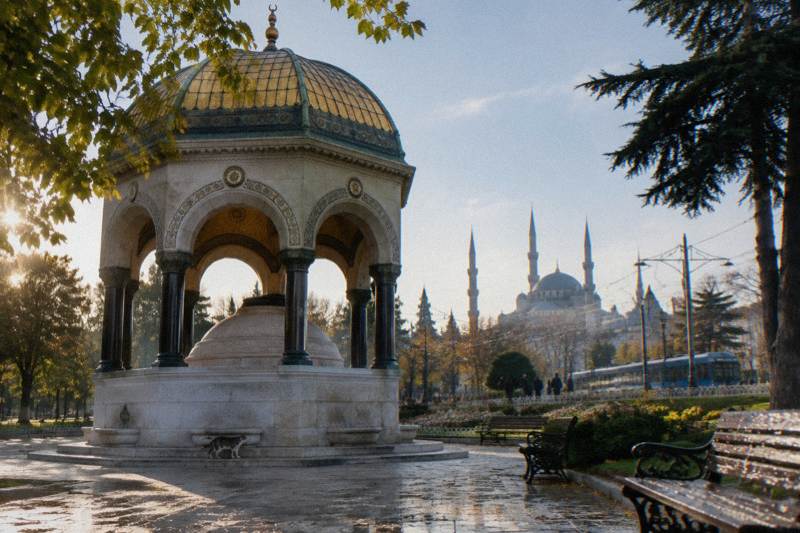
Back in the Old City, the shorter Constantinople walk, rated 4.97 out of 5 across 2,103 GuruWalk reviews, covers the imperial core in two and a quarter hours from the German Fountain, right at the Hippodrome's end, and makes a good primer if the three-hour tours feel like too much for one morning.
One note on the paid sites nearby, because the free/paid map in Sultanahmet is genuinely confusing. Topkapi Palace's outer courtyard, the First Court, can be walked through freely, but the palace itself and the Harem are ticketed, and the exact current pricing structure is one our research flags as contested between sources. The Archaeology Museums next door are ticketed too. The full picture, including which courts cost nothing, is in the site's guide to whether Topkapi Palace is free. The short rule of thumb: mosques and outdoor space in this neighbourhood are free, state museums are not.
For a sense of how far the free-walk roster stretches beyond Sultanahmet, the directory at Free Things To Do In Istanbul covers 33 verified GuruWalk walks across the Old City, the Asian side, Fener and Balat, Galata and Beyoglu, and the night walks, plus one freetour.com exclusive. The Old City cluster is the largest, and the Blue Mosque sits at the centre of it. This stop sits on a free walking route, Illuminated Night History Walk.
If your day is built around the mosque, the practical sequence is a morning walk, the mosque interior before the midday pause, the Hippodrome and Gulhane Park through the afternoon, and one of the neighbourhood's evening options afterwards. The night walk of illuminated Sultanahmet, rated 4.87 out of 5 across 238 GuruWalk reviews, covers the mosque and Hagia Sophia after dark, when the floodlit domes do most of the work. One of the free walking routes passes through here: Classic Old Town Walk.
For visitors who want a guided experience but prefer a different corner of the city, the roster's most distinctive alternatives cluster in the daily-life and Fener and Balat themes:
Common Questions About The Blue Mosque
Is the Blue Mosque free to enter?
Yes, completely free, both for worshippers and for visitors. There is no ticket, no donation and no separate charge of any kind. The conditions are modest dress and visiting outside the prayer-time pauses.
Do I need to pay for a scarf or covering at the entrance?
No. The mosque provides free loan garments, wraps, scarves and shoe bags at the tourist entrance, and you return them on the way out. You never need to buy anything to enter.
How long is the Blue Mosque closed for prayers?
The tourist entrance pauses for roughly 30 to 90 minutes around each of the five daily prayers, with the longest closure on Fridays around the midday Jummah prayer. Prayer times shift with the seasons, so check a prayer-time app on the morning of your visit.
Is the Blue Mosque's restoration finished?
Largely, yes. The multi-year restoration is described as largely complete, with most of the interior visible again, the courtyards fully open, and only minor sections such as parts of the Imperial Box still partially cordoned.
Can I take photos inside the Blue Mosque?
Yes, photography is permitted in the visitor zone of the prayer hall. Do not photograph worshippers or anyone at prayer, and keep noise to a minimum while the mosque is in religious use.
Which is free, the Blue Mosque or Hagia Sophia?
The Blue Mosque is free in full. Hagia Sophia is free only on its ground-floor worship space; its upper gallery carries a dedicated ticket for foreign visitors. The two buildings follow different ticketing models despite facing each other across the same park.