Is Hagia Sophia Free To Visit? The Honest Answer For Foreign Tourists
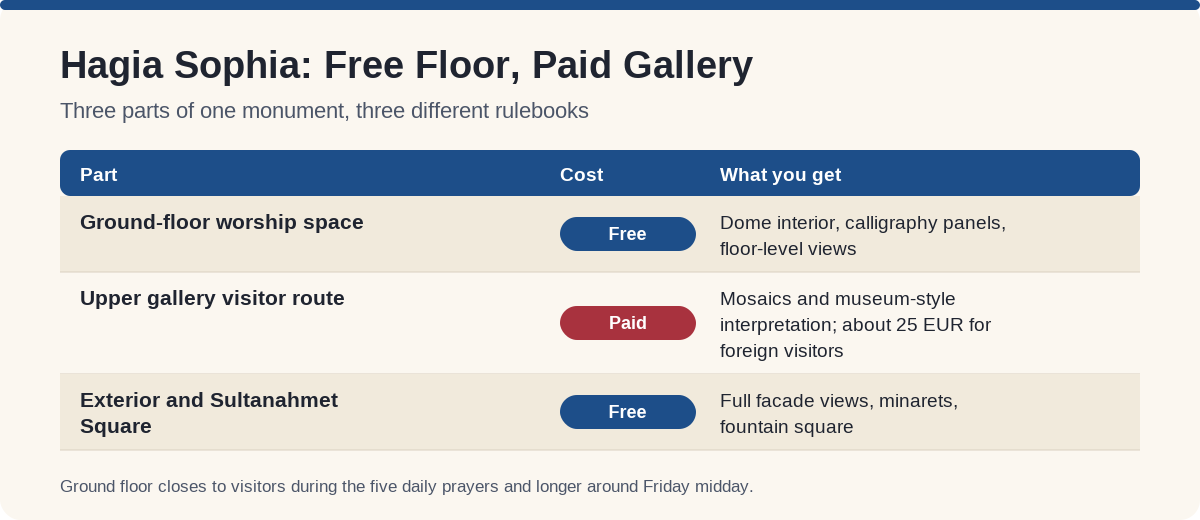
The honest answer is no, not for most foreign visitors. Since January 2024 Hagia Sophia has run two separate routes: the ground-floor prayer hall, free for worshippers entering to pray, and a paid visiting area of around 25 EUR that foreign non-Muslim visitors reach by ramp to reach the gallery floor.
Short answer
Hagia Sophia is free only for worshippers: Turkish citizens and foreign Muslims entering from the main gate at Hagia Sophia Square to pray. Foreign non-Muslim visitors use a separate visiting-area gate facing the Sultan Ahmed III Fountain and pay about 25 EUR, children under 8 free with ID. The Museum Pass does not cover it. The free alternatives are the exterior, Sultanahmet Square and the Blue Mosque next door.
The honest answer to "is Hagia Sophia free?" is no for most foreign visitors, and the reason is a rule change that many older guides still get wrong. Since 15 January 2024 Hagia Sophia has operated two routes. The ground-floor prayer hall is reserved for worshippers: Turkish citizens, and foreign Muslims who enter from the main gate at Hagia Sophia Square to pray, free of charge. Foreign non-Muslim visitors are not sent to the ground floor at all. They use a separate visiting-area gate, the one facing the Sultan Ahmed III Fountain, buy a ticket of about 25 EUR, children under 8 free with ID, and climb by ramp to the gallery floor, with views over the sanctuary and the Byzantine mosaics.
This guide breaks the question into its two real parts: who can actually enter free and under what conditions, and what the roughly 25 EUR visiting-area ticket buys. It also covers prayer-time pauses, the 10:00 cleaning closure, the ongoing restoration scaffolding, dress rules, and how a free walking tour fits around a visit, since the building sits at the heart of the Sultanahmet cluster this whole site is built around.
Is Hagia Sophia Free To Enter?
No, not for a foreign non-Muslim tourist. The ground-floor prayer hall is free, but only for worshippers: Turkish citizens, and foreign Muslims entering from the main gate at Hagia Sophia Square to pray. Everyone else uses the separate visiting-area gate facing the Sultan Ahmed III Fountain and pays about 25 EUR, children under 8 free with ID. There is no free way inside for a general foreign visitor.
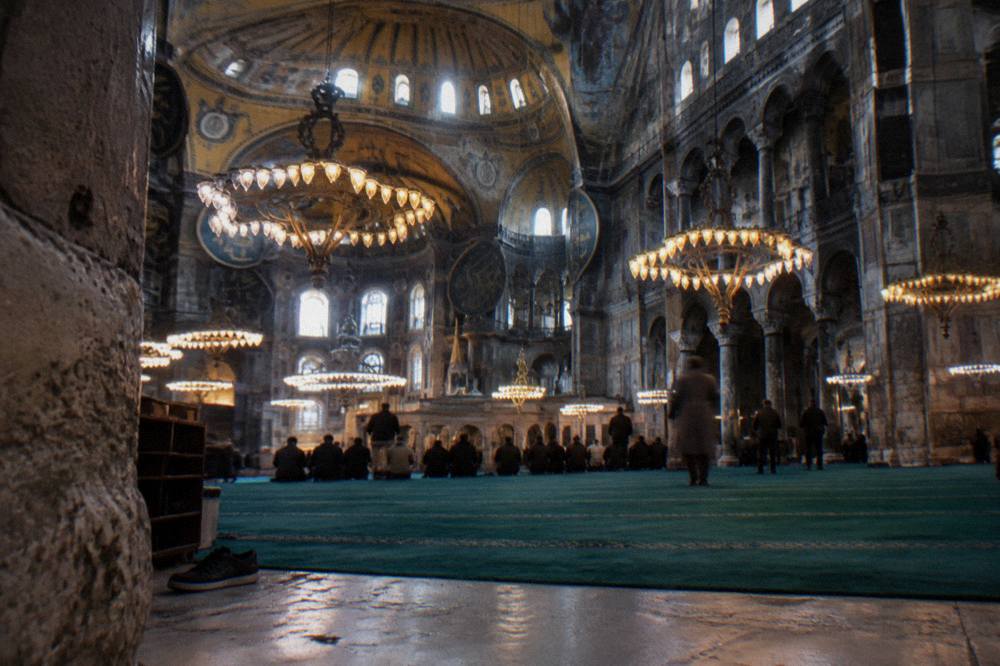
Treat those as two separate routes, not one building with one rule. The worshipper route is exactly what it sounds like: you come through the main gate at the square, remove your shoes, and enter the prayer hall beneath one of the largest domes ever built. It is free because it is an act of worship, not sightseeing, and it is not open to general tourism.
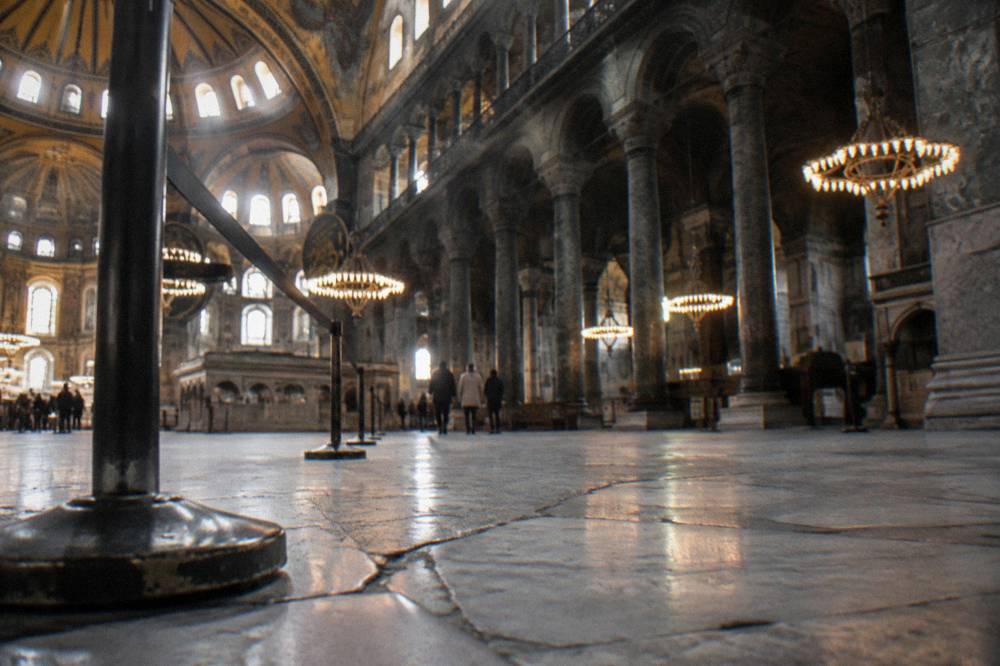
The visitor route is the paid one. Foreign non-Muslim visitors enter through the gate facing the Sultan Ahmed III Fountain, buy a ticket of about 25 EUR, children under 8 free with ID, and the route climbs by ramp to the gallery floor, where the views over the sanctuary and the Byzantine mosaics are. Headscarves and body covers can be bought at the booth for a small fee if you arrive without them. Before the 2020 reconversion, when Hagia Sophia operated as a museum, one ticket covered the whole interior. That arrangement is gone. One of the free walking routes passes through here: 3-Hour Old City & Daily Life.
| Route at Hagia Sophia | Cost | What you get | Who runs it |
|---|---|---|---|
| Ground-floor prayer hall | Free | Dome interior, calligraphy panels, prayer atmosphere | Mosque worship function under Diyanet, for worshippers entering to pray |
| Gallery visiting route | About 25 EUR, children under 8 free with ID | Ramp climb, gallery floor, views over the sanctuary, the Byzantine mosaics | Ministry of Culture and Tourism, ticketed via its museums system |
| Exterior and Sultanahmet Square | Free | Full facade views, minarets, the Imperial Gate from outside, the fountain square | Public space |
One more thing worth being blunt about: the Istanbul Museum Pass, the roughly 105 EUR five-day pass covering about thirteen state museums, does not include the Hagia Sophia visiting route. If a pass seller or street tout tells you otherwise, they are wrong or lying. The ticket is a standalone purchase, and the Museum Pass covers a different set of sites entirely, Topkapi Palace, the Archaeology Museums and their peers. A free walk covers this ground: Best-Of Walk, English Or Spanish.
What Can You See And Do For Free Around Hagia Sophia?
The genuinely free experience is everything outside the ticket gate: the full exterior from Sultanahmet Square, the Imperial Gate viewed from outside, the minarets, the fountain square, and the layered history a free walking tour unpacks. Inside, only worshippers enter free. Foreign tourists who want the interior pay the roughly 25 EUR gallery ticket. The free exterior visit can fill a satisfying hour on its own.
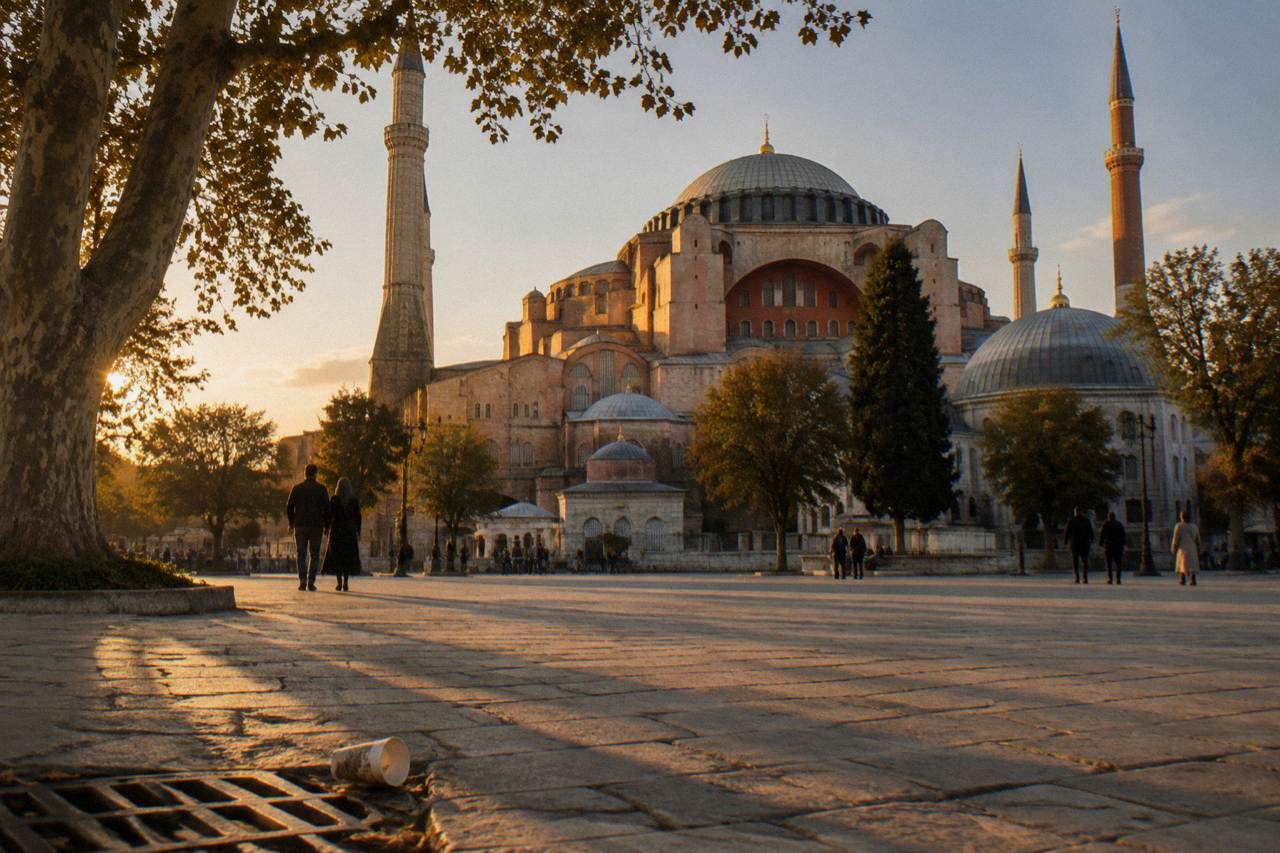
The exterior is the point of the free visit. The building commands Sultanahmet Square from every angle, and walking its perimeter costs nothing: the massive buttresses, the four minarets added across different Ottoman eras, the courtyard gates, the fountain of Sultan Ahmed III sitting at the visiting entrance. The scale that makes Hagia Sophia famous is fully legible from outside, and the square around it is one of the great free public spaces in the city.
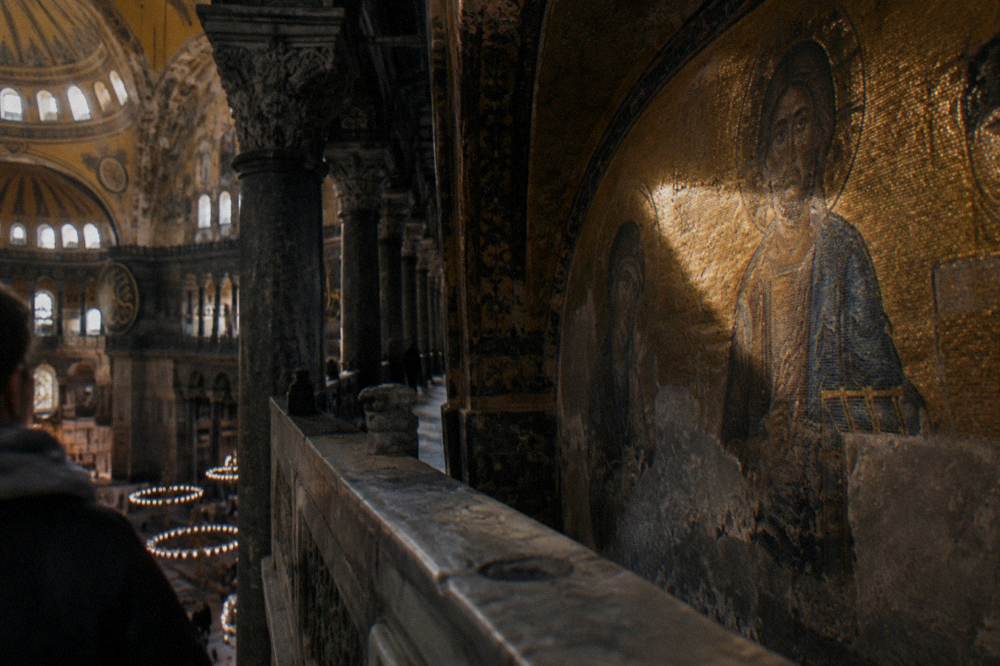
What you miss without paying is the interior. The Deesis, the haunting three-figure mosaic of Christ, the Virgin Mary and John the Baptist, sits in the upper south gallery, and the close-up views belong to the ticketed route. Whether that matters enough to justify 25 EUR is a genuine judgement call, not a requirement. Plenty of visitors, including plenty of reviewers on free-walking-tour listings, describe the exterior plus the Blue Mosque interior as the highlight of their entire Istanbul trip, at zero entry cost. This stop sits on a free walking route, Mosque Inner Visit Included.
Dress rules apply to anyone entering the building, on either route. Shoulders and knees stay covered, women cover their hair, and for the visiting route headscarves and body covers can be bought at the booth for a small fee. Our guide on what to wear visiting Istanbul mosques covers the full dress code, including what works in summer heat.
A free walking tour is the cheapest way to get the building's story, since licensed interior guides cost money and the free walks cover the exterior and history in depth. The Byzantine and Ottoman Tales free walking tour is the roster's most-reviewed Old City walk, rated 4.98 out of 5 across 3,553 GuruWalk reviews, and it runs three hours in English from Binbirdirek, a few minutes' walk from Hagia Sophia's door. This stop sits on a free walking route, Hagia Sophia Must-Sees, Spanish.
All three of those walks are free to reserve, GuruWalk-listed, and paid by tips at the end. The guide on free walking tours in Istanbul compares the full roster, including the Spanish-language walks, if you want the complete picture before committing an afternoon.
How Much Is The Visiting-Area Ticket, And Is It Worth It?
The Hagia Sophia visiting-area ticket costs about 25 EUR for foreign non-Muslim visitors, children under 8 free with ID. It is sold separately from everything else, is not covered by the Istanbul Museum Pass, and buys you the ramp climb, the gallery floor, the views over the sanctuary, the Deesis and the other Byzantine mosaics. Whether it is worth 25 EUR depends almost entirely on how much Byzantine mosaic detail you want.
The gallery route is genuinely a different experience from the square. The south gallery holds the Deesis, the mosaic many art historians rank among the finest Byzantine works surviving anywhere, along with the imperial portraits of Christ with Constantine IX and Empress Zoe. There is also the famous runic graffiti scratched into a marble balustrade by a Viking-age visitor, one of the building's strangest and most human details. The ramp corridors, the same sloping stone passages Byzantine courtiers once climbed, carry you up to all of it.
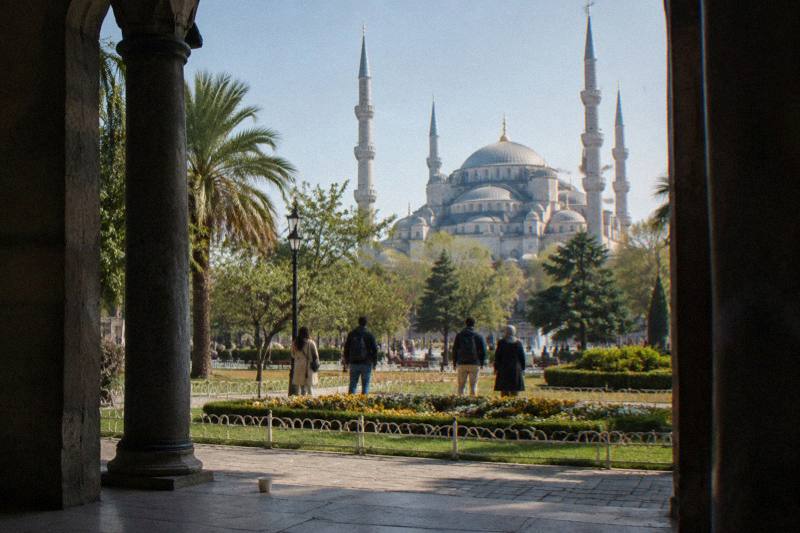
Is it worth it? If Byzantine art is why you came to Istanbul, yes, unambiguously, because the Deesis is not visible any other way. If you are a general visitor doing the Old City in two days, the exterior plus the Blue Mosque, the Basilica Cistern's exterior and the Hippodrome already fills an afternoon at zero entry cost, and the gallery can wait for a return trip. The Blue Mosque, free to enter as a worshipper or visitor, sits directly opposite and carries no separate museum ticket at all, which makes the comparison between the two buildings a planning decision in itself. One of the free walking routes passes through here: Haktan's Constantinople Walk.
| Visitor type | Best plan | Rough cost |
|---|---|---|
| Byzantine art enthusiast | Gallery visiting route | About 25 EUR |
| General first-time visitor | Exterior plus Blue Mosque plus a free walking tour | 0 EUR entry, tip for the guide |
| Museum Pass holder | Pass covers other state sites, not the Hagia Sophia route | Pass price plus 25 EUR if you want the gallery |
| Short layover visitor | Exterior and Sultanahmet Square only | Free |
When Is Hagia Sophia Open, And How Do Prayer Times Change Your Visit?
Hagia Sophia's praying area is closed to visits until 10:00 daily for cleaning, plus around each of the five daily prayers, and for longer around the Friday midday prayer. The gallery route keeps its own visitor hours. Prayer times shift later through autumn and winter as daylight shortens, so there is no fixed daily timetable, and you should check a prayer-time app or the on-site schedule on the day you visit.
This is the single biggest practical trap at Hagia Sophia, and it costs nothing to avoid. The building is a working mosque first, and access pauses for worship. The pauses are not announced weeks in advance because they follow the sun: the midday prayer might fall at half past one in July and after three in December. Arrive mid-pause and you wait outside, sometimes for the better part of an hour. One of the free walking routes passes through here: Essentials In 2 Hours.
The practical move is to build your Sultanahmet morning around two or three prayer windows and slot the free walking tours into the gaps. The roster's Old City walks cluster around Binbirdirek and the German Fountain, both within a two-minute walk of Hagia Sophia's doors, so the walks themselves are effectively Hagia Sophia-adjacent. The Essentials of Istanbul free walking tour, rated 4.97 out of 5 across 2,103 GuruWalk reviews, runs two and a quarter hours in English from the German Fountain, a schedule that fits neatly between morning prayers.
Fridays need extra margin. The congregational midday prayer is the week's biggest service, and the visitor pause around it runs longest. A Friday visit is not impossible, far from it, but budget a longer wait and expect the largest crowds of the week in Sultanahmet Square outside.
The restoration is worth knowing about before you go, because first-time visitors are sometimes startled by the scaffolding. The main dome is currently covered during the works, and reports on the restoration's progress confirm the building stays open throughout. The interior you see is a working construction site at the edges and a functioning mosque at the centre. Visitors planning a 2026 trip can also find current entry details in dedicated 2026 visiting guides that track the scaffolding and prayer schedule together.
What Free Things Sit Within Walking Distance Of Hagia Sophia?
The entire Sultanahmet cluster around Hagia Sophia is largely free to walk: the Blue Mosque is free to enter, the Hippodrome's obelisks and German Fountain stand in open public space, Gulhane Park's grounds cost nothing, and Topkapi Palace's outer First Court can be walked through for free, though the palace itself and the Harem are ticketed. The Basilica Cistern is paid, and sources differ on its current arrangements after a 2026 management change.
Start with the Blue Mosque, directly across the square. It is free to enter as a worshipper or visitor, requires modest dress, and carries no museum ticket of any kind, which makes it the cleanest "free" in the whole district. Its own multi-year restoration is largely complete, and most of the interior is visible again.
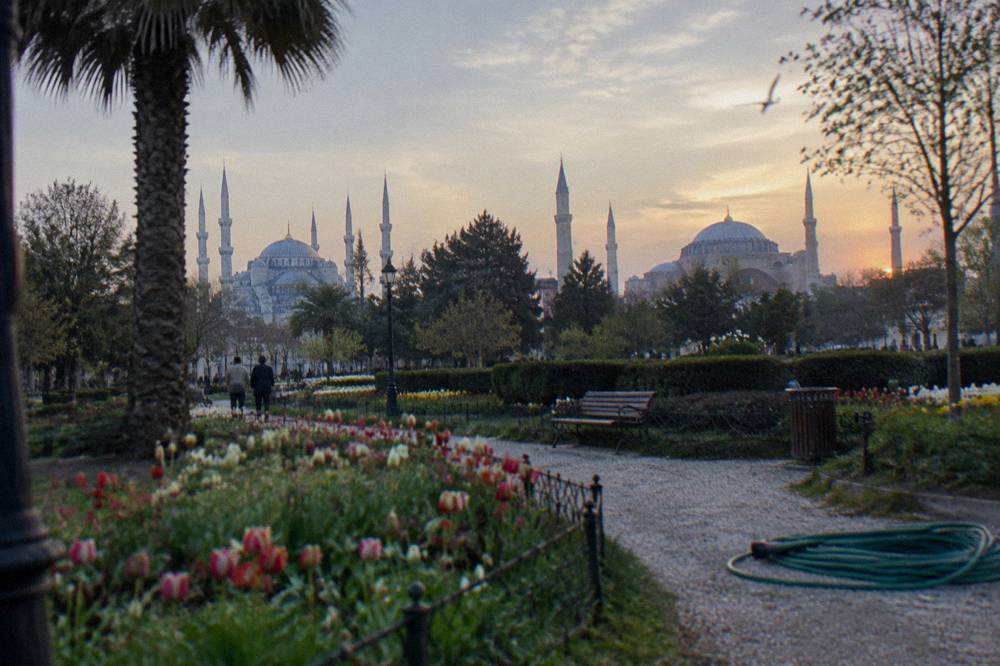
The Hippodrome, the long open plaza between the two great buildings, holds the Egyptian Obelisk, the Serpent Column and the German Fountain in free public space, and it doubles as the meeting point for most of the Old City's free walking tours. Gulhane Park, the wooded slope below Topkapi's walls, is free grounds with views over the Sea of Marmara and the incoming ferries. One of the free walking routes passes through here: Highlights Plus Secret Gems.
Topkapi Palace needs the two-fact treatment. Its outer First Court is a free public through-route, but the palace itself and the Harem are ticketed, and sources differ on the current ticketing structure: older accounts describe a separate Harem ticket, while a 2026 source describes one combined foreign-visitor ticket covering the palace, Harem and Hagia Irene. Treat the exact structure as something to confirm at the gate rather than a settled fact. The full Topkapi Palace free guide keeps the current picture.
The Basilica Cistern is the district's other big underground draw, and it is paid, with its ticketing arrangements in flux since a June 2026 management handover to the state foundations body; sources differ on the current setup, so check before queuing. The Basilica Cistern guide tracks what is known. One of the free walking routes passes through here: 3-Hour Byzantine & Ottoman Tales.
Free walking tours knit all of this together, and the ferry-side walks add the water. The Two Continents free walking tour, rated 4.94 out of 5 across 2,735 GuruWalk reviews, starts from the Cankurtaran streets just below Hagia Sophia and runs two and a half hours in English, crossing to the Asian side by public ferry at the standard transit fare.
Can You See Hagia Sophia Properly Without Paying Anything At All?
From the outside, yes, and the outside is generous: the exterior and Sultanahmet Square, the Blue Mosque interior, the Hippodrome monuments and Gulhane Park together cost nothing, and a free GuruWalk walking tour adds the building's full story with the guide paid by tips. But there is no free way for a foreign tourist to get inside Hagia Sophia itself. The interior belongs either to worshippers or to the roughly 25 EUR ticket.
The honest framing is this: the gallery ticket is not an optional add-on to a free visit, it is the only interior route a foreign non-Muslim visitor has. What stays free is real: the facade, the square, the layered history a guide unpacks outside, and the Blue Mosque directly opposite, where the interior genuinely costs nothing. Visitors who skip the Hagia Sophia ticket and spend the difference on time in the square and the mosques around it are not short-changing themselves. A free walk covers this ground: Anıl's Essentials Walk.
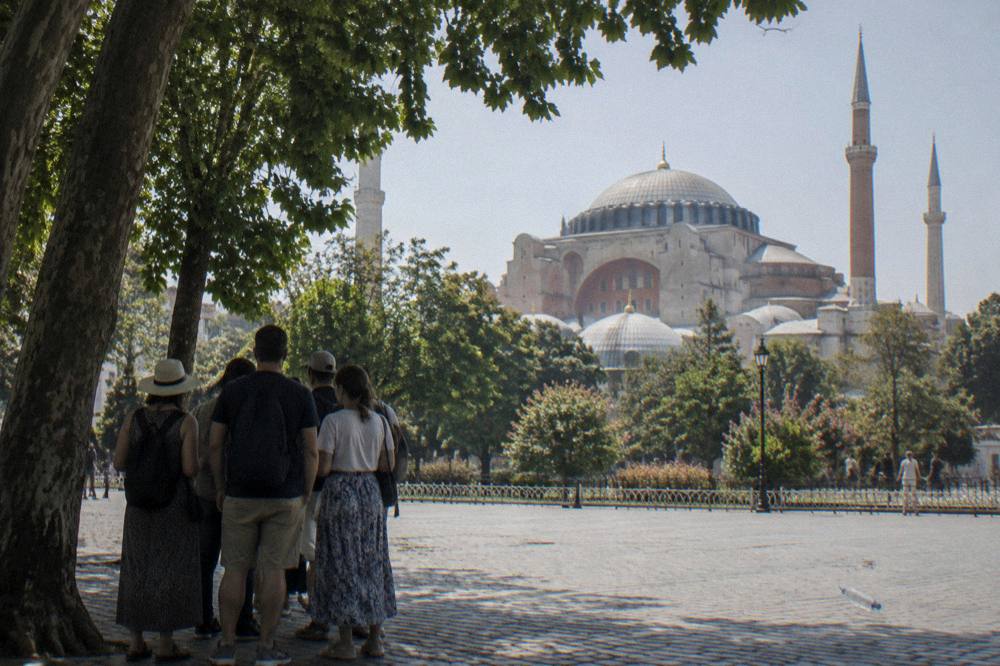
The free walking tours are the difference between looking at the building and understanding it. The Old City's most-reviewed English walk, the Byzantine and Ottoman Tales tour, spends its first stretch in the space between Hagia Sophia and the Blue Mosque, unpacking the church-to-mosque-to-museum-to-mosque sequence that makes this building the most contested piece of architecture in the city. Reserve it free, join at Binbirdirek, and tip the guide what the three hours felt worth. Our tipping guide for free walking tours covers how visitors actually handle that moment, without any invented customary figure, because there is no required amount and the walks are genuinely open to everyone. One of the free walking routes passes through here: Classic Old Town Walk.
If your Hagia Sophia day is your first day in the city, the Essentials of Istanbul walk from the German Fountain is the tighter two-and-a-quarter-hour loop, and it leaves the rest of the afternoon for the gallery ticket if you decide you want the interior after seeing the exterior.
How To Plan A Free Hagia Sophia Day, Hour By Hour
A workable free Hagia Sophia day runs: the exterior and Sultanahmet Square in the early morning, the Blue Mosque once it opens to visits, the Hippodrome and Gulhane Park before midday, and a free walking tour in the afternoon slot, with the gallery ticket added only if the mosaics matter to you. Total entry cost for the free version: zero. Total walking distance: under two kilometres, all inside Sultanahmet.
| Time | What to do | Cost |
|---|---|---|
| Early morning | Hagia Sophia exterior and Sultanahmet Square, before crowds build | Free |
| Mid-morning | Cross to the Blue Mosque interior | Free |
| Late morning | Hippodrome monuments, German Fountain, Gulhane Park | Free |
| Midday | Lunch in the Cankurtaran back streets | Street prices |
| Afternoon | Free GuruWalk walking tour of the Old City | Free, tip the guide |
| Optional add-on | Hagia Sophia gallery route, if the mosaics call | About 25 EUR |
Two practical notes finish the plan. First, the whole district is walkable and flat between the major sights, though Gulhane Park and the Cankurtaran streets slope toward the sea, so wear shoes that come off easily for the mosque visits. Second, the best time of day for a free walking tour matters more in Sultanahmet than anywhere else in the city, because the tour's starting points sit inside the same prayer-pause rhythm that governs Hagia Sophia itself.
Everything on this page, the free square, the free Blue Mosque, the free walks, is exactly what Free Things To Do In Istanbul exists to map: the parts of this city that cost nothing and reward the most. The Blue Mosque and the square belong on that list without an asterisk. Hagia Sophia's interior belongs on a different list: free for worshippers, and for everyone else a paid route that is genuinely worth its price to the right visitor.
Common Questions About Hagia Sophia Being Free
Is Hagia Sophia free?
Only for worshippers. The ground-floor prayer hall is free for Turkish citizens and foreign Muslims who enter from the main gate at Hagia Sophia Square to pray. Foreign non-Muslim visitors use a separate visiting-area gate and pay about 25 EUR, children under 8 free with ID.
Do I need to pay to enter Hagia Sophia as a tourist?
Yes, if you are a foreign non-Muslim visitor. There is no free entry route for general tourism. The visiting-area ticket of about 25 EUR is the only interior option, reached via the gate facing the Sultan Ahmed III Fountain and the ramp up to the gallery floor.
Does the Istanbul Museum Pass cover the Hagia Sophia gallery?
No. The Museum Pass covers roughly thirteen state museums including Topkapi Palace and the Archaeology Museums, but it excludes the Hagia Sophia visiting route. The ticket is bought separately.
Can I see the Hagia Sophia mosaics for free?
No. The mosaics, including the Deesis, sit on the paid gallery route, and the ground floor is reserved for worshippers rather than general sightseeing. The free alternative is the exterior and Sultanahmet Square, plus the Blue Mosque interior next door.
Is Hagia Sophia open during the restoration?
Yes. The restoration work, currently advancing to the eastern semi-dome, uses interior and exterior scaffolding but does not interrupt worship or visits. The main dome is covered during the works.
What are the rules for entering Hagia Sophia?
Dress rules apply on both routes: shoulders and knees covered, and a headscarf for women, with headscarves and body covers available to buy at the booth for a small fee. The praying area is closed to visits until 10:00 daily for cleaning, plus around each of the five daily prayers, and longer around the Friday midday prayer.