How Much Should You Tip A Free Walking Tour Guide In Istanbul?
A plain answer to the tipping question on Istanbul's free walking tours: how the pay-what-you-want model works, what to weigh, and how to hand over the tip without awkwardness.
How Much Should You Tip A Free Walking Tour Guide In Istanbul?
There is no required amount, and any guide or listing that implies otherwise is bending the model. A free walking tour in Istanbul costs nothing to reserve, the guide is paid entirely by tips, and the figure is yours to set. What most visitors do is match the tip to the walk's length, the guide's effort and what the two or three hours were worth to them, in cash, at the end.
That answer feels slippery, so this article pins down everything around it: how the pay-what-you-want system actually functions, what should realistically move your number up or down, and the small logistics, cash, currency, timing, that make handing over a tip feel normal rather than awkward. None of this is a rulebook. The whole premise of the model is that you decide after the walk, not before it.
One thing worth saying early: a visitor who cannot tip, or who tips very little after a disappointing walk, is not breaking anything. The model is built to absorb that. Guides on GuruWalk, the platform where nearly all of Istanbul's free walks are listed, know their income is variable. What the model asks of you is honesty: pay what the experience was actually worth, no more, no less.
If you are still choosing which walk to take, the three below are a reasonable shortlist from the city's roster: a compact Sultanahmet option, a broad essentials walk, and a Galata-side alternative.
How Does A Free Walking Tour Actually Make Money?
Every walk on this site's roster is listed as free or pay-what-you-want, and the guide's entire income from it comes from tips. GuruWalk, the platform hosting 33 of Istanbul's verified free walks, charges nothing to join and nothing to reserve; the money that reaches the guide is what the group hands over at the end. That is the whole business model, and it is why the tip is not a courtesy but the product's price.
The mechanics are simple. You reserve a spot, usually for a nominal fee on GuruWalk that is refunded or credited when you show up, designed to cut no-shows rather than to charge you. You meet the guide at the listed meeting point. You walk. At the end, the guide makes a low-key announcement that tips are welcome, and the group disperses while people hand over cash.
The guide is an independent local operator, not an employee of the platform or of any tourism board. Some run walking tours full time; many are students, historians or licensed guides filling the gaps in a seasonal city. Their income per walk is the sum of what a group of perhaps fifteen or thirty people each decided the walk was worth. On a strong day that is a living; on a rainy Tuesday with four guests it can be close to nothing.
This is why the question of how much to tip matters more here than it would for a salaried museum attendant or a bus driver. The tip is not a bonus on top of a wage. It is the wage. If you want the fuller picture of the model, including what "free" honestly means on these walks, the companion piece is a free walking tour actually free breaks down the economics from the visitor's side.
It also explains why guides on these walks tend to be notably good. The pay-what-you-want market is brutal feedback: a guide who phones it in earns badly, and the platform's review system makes that visible to future guests. Istanbul's roster reflects the result. The most-reviewed Old City walk on the site's roster sits at 4.98 out of 5 across 3,553 GuruWalk reviews, and even the roster's smaller walks mostly hold ratings above 4.7. Reviews that mention the guide by name and praise the storytelling are common across the catalogue.
What Should Actually Change The Amount You Tip?
Four things move the number: the walk's length, the group's size, the guide's quality, and your own budget. Length is the easiest to justify, since a three-hour walk is twice the work of a 90-minute one. Quality is the one guides hope moves it most. Group size cuts both ways: a big group spreads the tip pool, a tiny one concentrates the obligation. Budget is a legitimate constraint, not an excuse.
None of these come with a price tag attached, because there is no tariff. But you can reason about them the way you would reason about any service. Here is how each factor tends to work in practice on Istanbul's walks.
| Factor | Why it matters | How it tends to affect the tip |
|---|---|---|
| Walk length | Istanbul's free walks range from the shortest highlights slots to routes past the three-hour mark; a longer walk is more of the guide's day | Longer walks justify a proportionally larger tip |
| Group size | A large group shares the cost across many tippers; a group of three cannot | Small groups often tip more per person to compensate |
| Guide quality | Preparation, storytelling, answering questions, pacing the route | The single biggest driver of generous tips in guest reviews |
| Extra effort | Restaurant recommendations, photo help, route adjustments, waiting for latecomers | Recognised and rewarded by most guests who mention it |
| Your budget | The model explicitly welcomes visitors who cannot pay much | A modest tip after a good walk is entirely within the rules |
The quality factor deserves a plain word. The roster's review base, 28,557 reviews across the 33 GuruWalk walks, gives you a genuine signal before you book. A walk holding 4.94 out of 5 across 2,735 reviews, like the Two Continents ferry walk, has been judged by a very large crowd; a 4.93 across 41 reviews is a strong but thin sample. Reading a handful of reviews before you reserve tells you what past guests thought the experience was worth, which is a better anchor for your own number than anything a stranger could prescribe.
Duration is the most objective factor, and the roster makes it easy to weigh. The Premium Old Gems walk, for instance, takes the shortest slot on the entire roster, rated 4.75 across 186 GuruWalk reviews, and it exists precisely for visitors who want the highlights without a three-hour commitment. If you are comparing walks, the Premium Old Gems tour page lists the meeting point and current details.
A shorter walk also simplifies the arithmetic rather than cheapening it: the honest number for a brief highlights loop is simply lower than for a three-hour route, and nothing about that is a slight to the guide. If what you actually need is a first orientation of Sultanahmet before exploring the Old City on your own, a compact walk is the right shape of day, and the tipping decision that follows it is correspondingly lighter.
Should You Tip In Turkish Lira, Euros Or Dollars?
Cash, in whatever currency the guide can actually use, which in Istanbul overwhelmingly means Turkish lira or euros. Guides on these walks handle tips in both, and many also accept dollars, but lira is the safest default because it is what the guide spends. Cards are not a reliable option: most of these walks end on a street corner, not at a till, so plan to have notes in your pocket before the walk starts.
The practical advice is unglamorous. Withdraw cash the day before. Break large notes at a shop or a simit stall so you are not handing over a bill you cannot spare. Decide roughly what you will give before the walk ends, so the final minute is not improvised arithmetic in a crowd of thirty people dispersing in four directions. The rest of the planning pages sit on Free Things To Do In Istanbul.
Euros are widely accepted because Istanbul's tourist economy runs on them at the edges, and a guide can convert them easily. Dollars work too, though the guide carries the exchange burden. If you are coming from a euro or dollar country and have leftover currency, a tip is a perfectly good way to spend it. Lira, though, involves nobody in a conversion.
One cost worth planning for is getting to the meeting point, which is not free even when the walk is. A single Istanbulkart ride costs 46.20 TL at 2026 fares, and the card itself costs about 165 TL before you load credit, so budget a small transit buffer on top of whatever you plan to tip. The meeting points on this roster are transit-friendly: most Old City walks meet at Binbirdirek or the German Fountain in Sultanahmet, both a short tram ride from anywhere central. One of the free walking routes passes through here: Best-Of Walk, English Or Spanish.
When And How Do You Hand Over The Tip?
At the end of the walk, in cash, without ceremony. Guides typically close with a short, relaxed line that tips are appreciated, and then stand available while the group disperses. You walk up, say thank you, hand over the notes, and leave. There is no queue, no register, no suggested amount on a screen, and nobody records what you gave.
The moment is less awkward than first-time visitors expect, precisely because it is unstructured. Some people thank the guide and hand over an envelope-folded note. Some shake hands and pass the tip in the handshake. Some quietly approach while others are taking photos. All of it is normal. The only genuinely awkward version is dodging the guide's eye and slipping away, which happens, and which guides notice more than visitors assume.
If the walk was weak, you are allowed to reflect that. The model's honesty runs both ways: a tip that matches a mediocre walk is a truthful signal, and the review system carries the rest. If the walk was excellent, the same logic applies with the sign reversed. Reviews on the live listings frequently mention guides by name, and a generous tip plus a short written review is the combination guides value most, because the review keeps earning for them after you fly home.
Timing has one real edge case: walks that end inside a mosque or a busy square, where a public exchange of money can feel off-key. Guides on the roster handle this by ending at a cafe or a quiet corner rather than mid-monument. Follow the group, and the moment will present itself. For guidance on when in the day to take the walk in the first place, the piece on the best time of day for a free walking tour covers the light, the crowds and the prayer-time pauses that shape an Istanbul walk.
What If You Genuinely Cannot Afford To Tip?
Then you take the walk anyway. The pay-what-you-want model is built on the assumption that some visitors will pay little or nothing, and a guide who makes you feel unwelcome for that is failing at their own business. Istanbul's free walks exist partly as a budget-travel lifeline, and the roster's own reviews show guests openly thanking guides for walks they received while travelling cheaply.
This deserves emphasis because the question is often asked with real embarrassment. The economics of the model already price in the non-tippers: a guide running a walk for twenty people is doing so knowing perhaps a handful will tip generously, most will tip something, and a few will not tip at all. Your single absence does not collapse anything. What the model asks is that you not take a spot you will abandon, since no-shows are the one thing that genuinely costs guides, and that you leave a review if the walk was good, which costs nothing and pays forward.
There is also a middle path that is easy to forget: a small tip plus a strong review often helps a guide more than a large tip alone. The 33 GuruWalk walks on this roster compete on ratings and review counts, and a thoughtful paragraph from a guest who tipped modestly still moves that needle. If the question of safety or legitimacy is what is holding you back rather than money, the site's write-up on whether GuruWalk is safe and legit covers how the platform vets guides and handles disputes.
The roster's smaller walks are a natural fit for tight budgets. The Essentials Istanbul walk, rated 4.93 across 41 GuruWalk reviews, runs two hours from Binbirdirek near the German Fountain and covers the Old City's core without a long commitment. Its Essentials Istanbul tour page has the meeting point and schedule details.
Do The Walks Themselves Differ Enough To Change What You Tip?
Yes, and duration is the clearest axis. The roster's walks run from a compact highlights loop to a full three hours and beyond, and a tip that feels generous after a short highlights walk would feel thin after a route that crossed a continent. Theme matters too: a food-and-daily-life walk and a night walk deliver different experiences, and visitors tend to tip against what the two or three hours actually held.
The Old City cluster is the largest group on the roster, sixteen walks concentrated around Sultanahmet, and it is where most first-time visitors start. The longest of them run a full three hours through the Byzantine and Ottoman layers; the shortest, like the compact Premium Old Gems walk, are deliberately trimmed. A short walk is not a lesser one, but the honest arithmetic of tipping does scale with the guide's time.
Beyond Sultanahmet, the roster spreads across five other clusters: the Asian side, Fener and Balat, Galata and Beyoglu, food and daily life, and night walks. The Two Continents walk, rated 4.94 across 2,735 reviews, includes a ferry crossing between Europe and Asia, which means the guide's effort includes transit logistics a Sultanahmet walk never faces. The Galata walks climb hills and stairs. The night walk, rated 4.87 across 238 reviews, runs the Old City by lamplight with a different rhythm entirely. This stop sits on a free walking route, Greek, Jewish & Armenian Balat.
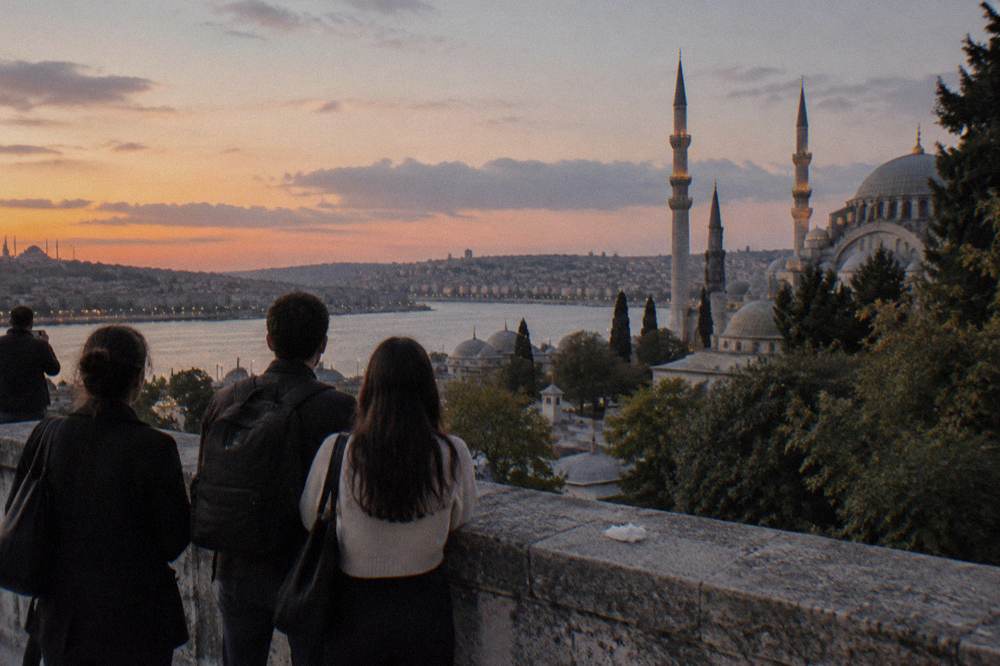
If you are planning a full day around the walk, note that some of Istanbul's headline attractions carry conditions a first-time visitor should know. Hagia Sophia's ground-floor worship space is free while its upper gallery is a separate ticketed route, and the Blue Mosque is free to enter with modest dress required. The site's guide to free things to do in Istanbul walks through which famous sites cost nothing and which carry a ticket, useful context when a walk's route brushes past them. A free walk covers this ground: 3-Hour Byzantine & Ottoman Tales.
The three walks below span that variety: a cross-continent ferry walk, a Galata-and-Taksim route, and the Old City after dark. Whichever you choose, the tipping logic in this article applies unchanged.
Common Questions About Tipping On Istanbul's Free Walking Tours
How Much Should You Tip A Free Walking Tour Guide In Istanbul?
There is no required amount. The walk costs nothing to reserve, the guide is paid entirely by tips, and the figure is yours to set based on the walk's length, the guide's quality and your budget. Bring cash, decide roughly what the experience was worth, and hand it over at the end.
Is tipping mandatory on a free walking tour?
No. The pay-what-you-want model means the tip is voluntary in every sense, and a visitor who cannot pay is still welcome. The one thing that genuinely costs a guide is a no-show, so cancel your reservation if your plans change.
Can I tip in euros or dollars instead of Turkish lira?
Yes. Guides on Istanbul's free walks regularly accept euros and dollars alongside lira, and leftover travel currency is a perfectly good way to tip. Lira is the default the guide can spend directly, but none of the three will be refused.
Should I tip before or after the walk?
After, always. The whole point of the model is that you pay based on the experience you actually received. Tipping in advance turns a pay-what-you-want walk into an unpriced one and removes your honest signal.
What if the walk was disappointing?
Tip less, or reflect it in a review, or both. The model's honesty runs both directions, and a tip that matches a mediocre walk is truthful feedback. A short written review matters to independent guides even more than the cash.
Do I need to book in advance or can I just show up?
Reserve on the guide's GuruWalk page. Reservations are free but capped by group size, and the small hold some walks use exists to discourage no-shows, the one thing that directly costs the guide a spot they could have given to someone else.